Why Do Kids Bunch Up in Soccer? How to Help U6, U8 and U10
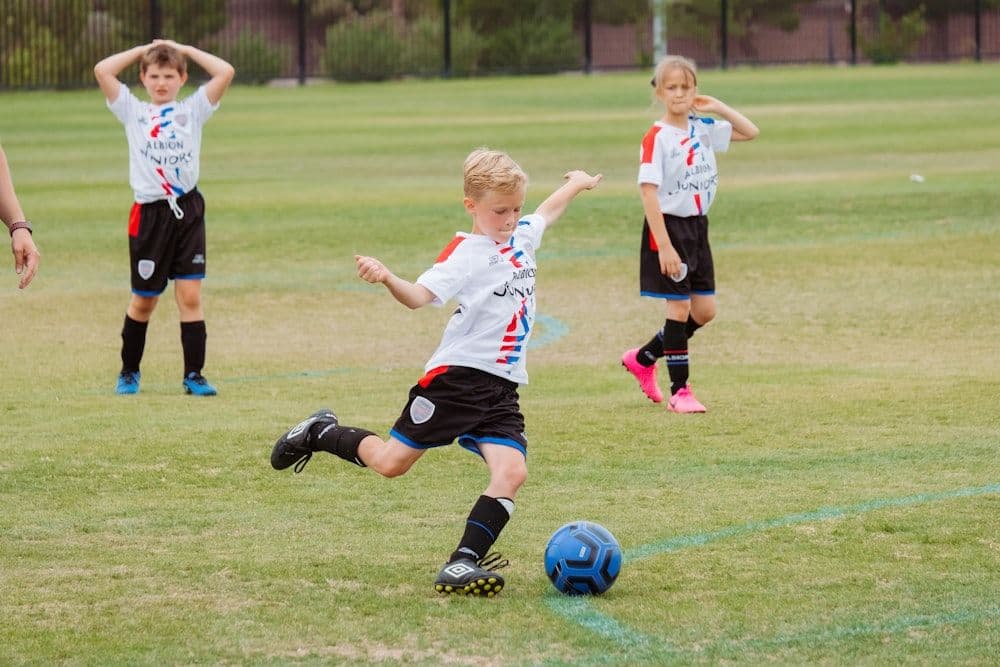
Kids bunch up in soccer because the ball is what interests them, and young players act on that interest. At U6, let them chase it. At U7 and U8, introduce games with more than one goal to attack. At U9 and U10, start using channels and zones to make space easier to see. Those are starting points, not deadlines for every child.
The FA calls ages 5 to 11 the foundation phase. There is a lot of growing inside that label. A five year old following the ball and a ten year old learning to switch play need different sessions.
Why do kids bunch up in soccer?
The FA's guidance on coaching four to six year olds explains it plainly: "Young children have less experience to draw on. This means the games will be driven by impulse and instinct. This means they will want to be on or near the ball."
That gives you a better starting point than assuming they ignored the team talk. The thing you want them to move away from is the thing they came to play with.
US Youth Soccer is equally direct in its Player Development Model: "let everyone know it is OK to play swarm ball at the U-6 and U-8 age groups. Swarm ball may actually help players improve their dribbling skills".
Notice the word "may". That is permission to let the game happen, not proof that every crowded game teaches dribbling well. You can still change the teams, reduce the number of players or give everyone their own ball.
Its spatial awareness supplement adds: "Psychosocially they must grow out of the egocentric phase." You do not need a developmental theory lecture before training. You need expectations that leave room for the age of the players in front of you.
When should U8 soccer players learn to spread out?
The US Soccer 4v4 framework has no spacing action in its age six row. At ages seven to eight, it lists "Spread out / Create passing options / Support the attack".
That is where you start offering reasons to move away from the ball. It does not mean a seventh birthday produces a winger who stays wide all afternoon.
At ages nine to ten, the 7v7 framework asks players to "Create a 2v1 or 1v1 / Change the point of attack / Outnumber the opponent". Those actions ask more of players than standing apart. They have to notice a defender, a teammate and another route towards goal.
Use the age bands to choose a starting game. Then watch what happens. If the players cannot find the second goal in a four-goal game, adding zones and another scoring rule is a lot to ask.
How to stop bunching in youth soccer without constant shouting
The US Youth Soccer Coaching Manual quotes Steve Sampson: "If a coach is constantly talking or yelling at players during the game, it prevents your players from thinking for themselves."
In our experience, "spread out" tells a seven year old what you want the pitch to look like. It gives them very little to do next. Which way? How far? What happens when their teammate loses the ball?
Give them something more concrete. Put a second goal away from the crowd. Let them attack it. If you stop the game, point out the available goal and restart with the same picture. Then leave enough quiet for someone to choose it.
Swarm ball at U6: what to leave alone
At U6, leave the swarm alone and organise around it. Our starting choice is a ball each, followed by 3v3 without goalkeepers. Use the basic game below for that final part. There is no need to hold a child beside a cone to preserve a formation. For the rest of the session, the U6 soccer practice ideas article has five games and a full plan.
 © CoachTruly.com
U8 soccer spread out games: give them more goals
Germany's DFB children's football guidance uses four goals: "Gespielt wird auf vier Minitore, jede Mannschaft verteidigt also zwei Tore". In English, that means four mini goals, with each team defending two.
The FA's four-goal practice guidance offers a progression: "if a team scores after switching the ball into the other half, reward them with two goals rather than one."
Start with ordinary scoring. Add that reward when the players understand which goals they are attacking.
1. Three against three with four goals
Put two goals at each end and play 3v3. Each team can score in either goal at the opposite end. Keep spare balls beside you and restart when one goes out. The bank version uses short matches and rotates a third team in.
 © CoachTruly.com
Why we use it: there is another target when a defender blocks one goal. Watch whether anyone notices it before telling them where to go. If you have enough room, use parallel pitches so the spare team plays too.
2. Three against three to different coloured goals
Use four goals marked in two colours. Raise a coloured cone or call the colour to show which goals are available. Restart quickly when the ball leaves the pitch.
 © CoachTruly.com
One change worth making: leave the colour alone for several attacks before changing it. Our aim here is to give players time to find the target. A constant stream of calls turns your voice into another thing to follow.
3. Three against three with six goals
Add a third goal at each end. Play 3v3 and let the quickest player collect a spare ball when one goes out. Agree which direction each team attacks before starting.
 © CoachTruly.com
Why we use it: you can ask the same question with more possible answers. Which goal is open? Keep the goals far enough apart that one defender cannot stand in front of all three.
4. One against one to four goals
Each player defends two goals. The defender passes to the attacker to start. If the defender wins possession, they attack the two goals at the other end.
 © CoachTruly.com
One change worth making: the bank drawing uses waiting lines. For this session, set up a pitch per pair where space allows. The choice between two goals stays the same, with both players involved on every turn.
5. Three teams with two balls
Give each team its own goal around the edge. Start two balls in the middle and send one player from each team to compete for them. Players score in their own team's goal. Rotate the active players after each round.
 © CoachTruly.com
Why we use it: this is our bank game, not federation advice. There are two balls to pursue. In our experience, it is a useful change when every player keeps following the same ball. Keep the teams small so the next round comes quickly.
Teach kids to spread out in football: U9 and U10 channels
The FA's guidance on space says: "Using channels helps players practise in-possession skills like: switching play using the width and depth of an area".
The US Youth Soccer supplement agrees: "Channels are useful when giving young players the notions associated with width or switching the point of attack." It places a "good feel" for thirds and channels at 12-U. Our suggestion is to start marking them at U9 or U10, then revisit them. Nobody has to finish learning space this season.
6. Four-zone 5v5
Divide the pitch into four areas. The ball must visit all four before a team scores. On winning possession, a team has five seconds to score before that condition returns. The coach supplies the next ball after a goal or when it goes out.
 © CoachTruly.com
Watch for: players finding a teammate in another zone. If counting visits takes over the game, return to four goals and try this another week.
7. A game with widening and narrowing
Mark wing channels. The team with the ball needs a player in each wing channel. The defending team gathers in the middle channels. Change roles when possession changes.
 © CoachTruly.com
One change worth making: let different players fill the wide spaces. Follow this with ordinary play and watch whether anyone moves wide without the channel rule.
8. End-zone game
Mark a scoring zone at each end. Score by passing to a teammate who arrives in the zone. The receiver cannot wait there for the ball. Restart with a spare ball after a goal.
 © CoachTruly.com
Watch for: a run that starts while the passer can still play the ball. Ask the receiver to try again if they arrive early and stand waiting.
9. Point-area game
Play with small goals and three areas. A goal from the large middle area scores one point. A goal from either smaller end area scores two. Players can move between areas freely.
 © CoachTruly.com
Why we use it: the zones change the reward while leaving movement open. Use it when you want to see which spaces players choose without assigning anyone a channel.
What to stop doing when players bunch up
- Stop repeating "spread out" over every attack. Choose one game that gives them somewhere useful to go.
- Put away the fixed-position cones for your youngest teams. Our preference under U9 is to mark targets and boundaries, then let players move.
- Stop judging the session by a still picture. Look for a player noticing another goal or offering a pass, even if the next attack becomes crowded again.
Where to find more
The games above are drawn up in our free drill bank. Choose one for the next session and keep the others for when your players need a different problem.