U6 Soccer Practice Ideas, and What to Stop Trying to Fix
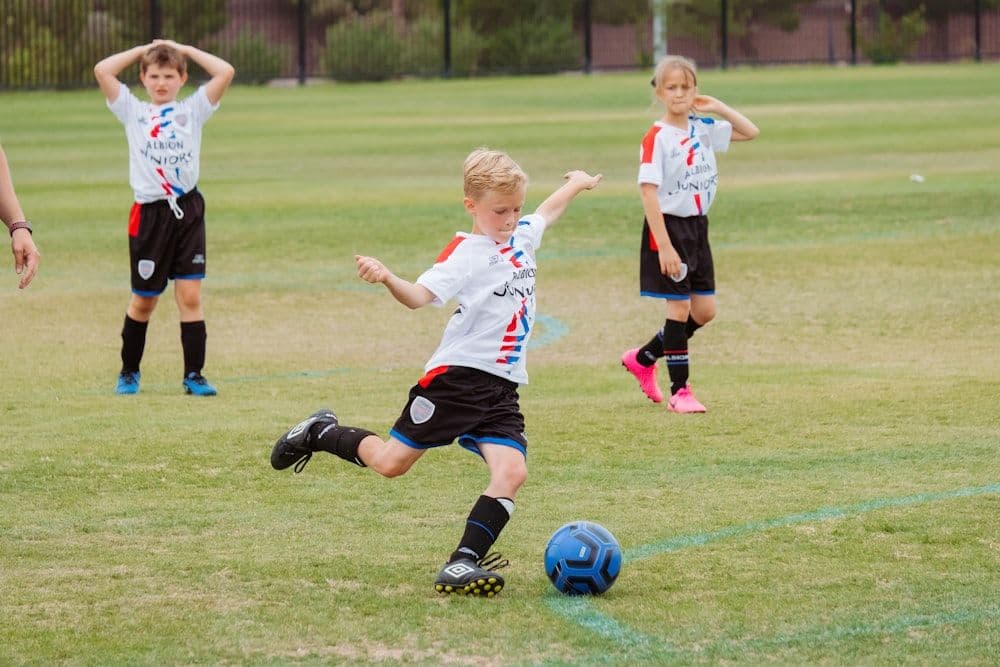
Most U6 advice is U10 advice with the numbers made smaller. Shorter drills, smaller pitch, same assumptions. Then you run it on a Tuesday with eleven five year olds and one of them is crying, one is watching an aeroplane, and the other nine are in a heap around the ball.
Here is what the frameworks actually say about this age, and five games that hold up.
"Spread out" is not a U6 instruction
US Soccer's Grassroots Player Development Framework lists the attacking actions it expects at each age. At age 6 there are two: shoot, and pass or dribble forward. That is the list.
"Spread out" and "create passing options" do not appear until the ages 7 to 8 row.
So when you shout it across the pitch and nothing happens, nothing is wrong with your players or your session. You are asking for something the framework does not expect for another two years. The same document sums up age six as "The ball is playing with me... I am playing with the ball," and only at seven to eight does it become "Playing with my friends."
It also tells you what to expect from them and from yourself. At six, players are "always in motion" and "small, incidental things are important." The coach behaviour it asks for is "appreciate the things they take seriously, even if you don't."
That is the whole job at this age. The shape comes later, on its own, and then you can coach it.
The real game is already tiny
If you have never read them, the US Youth Soccer Under 6 recommendations are worth five minutes:
- Three a side. Not seven, not five.
- No goalkeepers.
- No offside, no penalty area.
- Four eight minute quarters, with two minute breaks between them.
- Size 3 ball, and every player gets at least half the minutes.
Eight minutes is how long the actual competitive game asks a six year old to concentrate before it stops and gives them a drink. If the real match is built in eight minute blocks, a fifteen minute drill in training is not ambitious, it is just too long.
Not listening is not a discipline problem
The FA's guidance on coaching four to six year olds is blunt about the emotional weather: "One minute they cooperate peacefully, and the next, they are demanding." It also says plainly that parents and carers must be present to look after their child, which is worth repeating to your parents if you are currently doing both jobs.
Footy4kids puts the listening problem well: "Players do NOT learn by listening to a coach lecture. In fact this is the best way to make sure the kids tune out." Their point is that these kids have already spent all day at school being told to sit still and listen to an adult. Then they get outside, in the fresh air, with a ball.
The fix is not a firmer voice. It is letting them burn the energy first, and cutting the talking down to a sentence.
Five games that hold up at U6
All five are in our free drill bank. Diagrams below, no signup needed.
1. Mirror
One player or the coach is the Mirror and stands with their back turned. Everyone else lines up further away and moves towards them, running, walking or crawling. The Mirror can turn at any moment. Anyone seen moving goes back to the line, and if you are playing with a ball, the ball has to be stopped too. First to touch the Mirror takes over.
 © CoachTruly.com
Why it holds up: nobody queues, nobody is out, and stopping a ball dead is a genuine skill hidden inside a game they already know from the playground.
2. Apple thieves
Balls go in a middle area. One or two players are homeowners guarding them. Everyone else dribbles apples out to their own basket. Get touched by a homeowner and you leave the ball where it is and rejoin through your own basket. You cannot steal from another thief's basket.
 © CoachTruly.com
Why it holds up: getting caught costs you a ball, not your place in the game. That distinction matters a lot when the player getting caught is five. You can also let the homeowners chase outside the middle if the game needs more chaos.
3. Home exchange
Teams start with balls in their own home and dribble them out, one at a time, into anyone else's home. Once your home is empty you go and fetch balls from other homes to keep emptying yours. Balls can be stolen on the way and taken anywhere. Fewest balls at home when time runs out wins. Use at least as many balls as you have players.
 © CoachTruly.com
Why it holds up: every player has a ball at their feet almost the whole time, and the scoring is a count at the end rather than something you have to referee while it runs.
4. Listen and group up
Players move in a marked area, some with a ball and some without. You call out a group to form: "Four players, two balls!" They have to make it, quickly. Add a time limit, then make the calls harder: "Eight feet and two balls, two hands on the ground."
 © CoachTruly.com
Why it holds up: it turns listening into the game instead of the thing standing between them and the game. If you have a group that tunes you out, this is the one to run.
5. Land, sea, ship
Dribble to the line you call, and stop dead on it. Land, sea, ship, each one a marked line. Speed up the calls as they get it.
 © CoachTruly.com
Why it holds up: stopping the ball on a word is close control, and they will do fifty repetitions of it without once being told to keep the ball close.
One change worth making: the bank version finishes by eliminating the last player each round. At U6 that hands a drink bottle to the child who most needs the touches. Keep calling and let nobody go out.
A 45 minute session that survives
Built on eight minute blocks, because that is what the real game uses.
- Arrival, ball each, no organisation. Five minutes of nothing but touches while you wait for the late ones. This is the energy burn, and it is not wasted time.
- Mirror or land, sea, ship. Eight minutes. One sentence of explanation, then go.
- Apple thieves or home exchange. Ten minutes. Both are chaotic and both are supposed to be.
- Water and a sit down. Two minutes, properly.
- Three against three, no keepers. Fifteen minutes, in short games. Change the teams whenever it stops being close.
- Finish while they still want more. Always.
If it falls apart in the middle, go straight to the small sided game. It is the part they came for and the part the framework cares most about at this age.
What to stop doing
- Stop coaching shape. It is not in the age six list. It arrives at seven or eight.
- Stop explaining for longer than a sentence. Demonstrate, then start.
- Stop running anything past the point where they are still enjoying it, even if you had six minutes left on the plan.
- Stop treating the swarm as a failure. At five, the ball is the game. It sorts itself out later.
The single change with the biggest return at U6 is not a better drill. It is fewer words before each one.
Where to find more
The five games above are drawn up properly in our free drill bank, linked from each one. The fun theme is where most of the material for this age sits, and it is open with no signup.