Soccer Drills Without Lines: Four Youth Football Practice Swaps
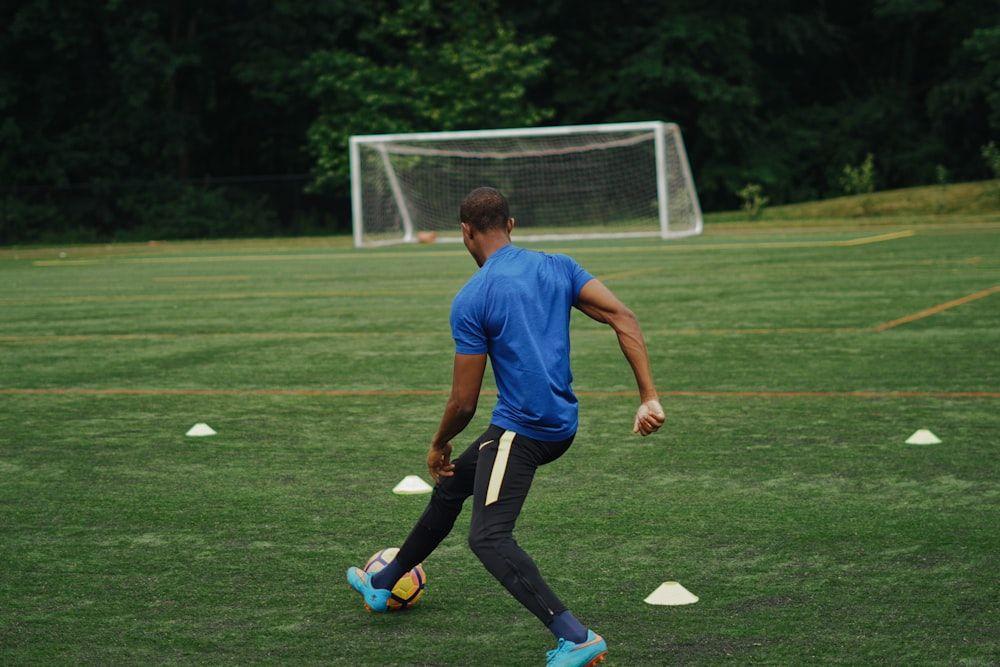
To run soccer drills without lines, split players into pairs or small games, give more of them a ball and use several targets. Replace warm-up laps with activity on the pitch. Replace a long shooting queue with small sided games or parallel contests. For U10 rondos, decide whether the players can use the passing choices, then add a direction or target if they need one.
This is mainly for the foundation phase, ages 5 to 11 in FA terms. Think U6, U8 and U10 in US age bands. The same setup will not ask the same amount of every group.
No laps, no lines, no lectures: what the advice means
The US Youth Soccer Coaching Manual has a heading called "Eliminating lines, laps and lectures". Under it: "running laps, especially without a ball, is a waste of time. All practice activities should take place on the field, preferably with a ball".
Tony Lepore made the same point in Soccer America in 2011: "Every good coaching manual I see now starts with the three L's: 'No laps, no lines, no lectures'".
Call it a US Youth Soccer coaching-manual principle. These sources do not establish who coined the phrase. They do give you a reason to look at what players actually spend training doing.
Ball rolling time: count the waiting players too
The FA's ball rolling time guidance says to "aim for 70% ball rolling time during a practice session". That is time with the ball in play, rather than time spent explaining, setting up or retrieving it.
Mark Carter's Ministry of Football discussion gives a shooting-queue example with continuous ball movement: "In this example there are 9 players, and each is involved for 1/9th of the time." That criticism is Carter's, not an FA rejection of its own measure.
Our check is to watch one player through a whole turn. How much of it is playing? How much is waiting? Repeat with someone at the back of the queue. A running stopwatch beside the coach cannot answer both questions.
1. Should kids run laps for a soccer warm up?
Pete Sturgess addresses adult-style preparation in the FA's pre-season guidance: "That sort of preparation isn't suitable for young players aged 5-12." His alternative is to "give them lots of touches by using the ball as much as possible."
Tim Bradbury's ENYYSA advice asks for "Sessions completely absent of LAPS, LINES AND LECTURES".
Keep a warm up in the session. In the 11+ Kids trial by Rössler and colleagues, involving 3,895 players with a mean age of 10.8, "The overall injury rate in the intervention group was reduced by 48%". That result belongs to the structured programme tested. It does not transfer to an improvised tag game or a lap with a ball.
Swap: dribbling with signals
Give everyone a ball and mark an area. Start with one signal to stop the ball and another to change direction. The bank game also has goals around the edge for a scoring signal. Add that once the first rules are clear.
 © CoachTruly.com
Footy4kids' warm-up advice asks players to "touch the football with every step they take". Use that as a close-control task for part of the activity. Let the group try different speeds rather than spending the whole warm up following you around a perimeter.
Swap: tag with goals and balls
Most players have a ball. They score points by dribbling around cones of different colours. The taggers try to win a ball and score in a goal at the edge. A player who loses possession tries to win it back. If the tagger scores, the player retrieves their ball and continues.
 © CoachTruly.com
Why we use it: losing the ball gives the player a next action straight away. Rotate the taggers between rounds so the same children do not spend the whole warm up chasing.
Swap: tail tag
Each player tucks a bib into their waistband. Collect tails while protecting your own. Losing yours does not put you out. Keep playing and try to win another.
 © CoachTruly.com
One change worth making: start without balls while the group learns the rules. Add the ball version when they can manage both tasks. This is our choice of progression, not a requirement for every age.
Swap: small games as players arrive
The Play-Practice-Play guide hosted by Iowa Soccer says: "As children arrive at practice, they immediately start playing small games".
Put goals out first and use the basic game below. Add players to the pitches as they arrive, keeping the teams small. You can begin the shared warm up once everyone is there.
 © CoachTruly.com
For more choices, use the six minute warm ups. You do not need to repeat the same opening every week.
2. Soccer drills without lines: replace the single-ball queue
One ball and a long line are easy to organise. Count how many players can use that ball at once before keeping the setup.
The US Youth Soccer manual gives an age-based guide: "under-6 players must each have a ball; under-8 players should use one ball in pairs; under-10 can share one ball among four players".
Its Player Development Model also stresses small groups: "Individual and small group play, especially pairs, is essential for both touches on the ball".
Four groups with four balls give you four places where someone can act at once. They do not guarantee four times as many touches per player. The rules, restarts and size of the groups still matter.
Swap: passing in pairs through gates
Give each pair a ball and two gates facing each other. Pass through your partner's gate. Move the gates closer if the ball keeps missing. The bank progression adds a first touch to the side before the return pass.
 © CoachTruly.com
Watch for: whether both players can keep the exchange going. Remove a touch limit before asking someone to hit a smaller target.
Swap: gate game in pairs
One player attacks and one defends. Score by dribbling through a gate with the ball under control. In this version, the defender returns the ball after winning it. Swap the attacking role on a timer.
 © CoachTruly.com
Why we use it: both players have a job on each attempt. The timed swap gives each player a turn carrying the ball, even when one defender wins it repeatedly.
Swap: one against one with teams
Put spare balls in the middle and defenders beside several goals. Attackers collect a ball and choose a goal, with only one attacker using a goal at a time. After the attempt, collect a new ball and move to the next goal. Count goals and swap roles when the supply runs out.
 © CoachTruly.com
Watch for: a queue forming at the same goal. Keep the rotation clear and use enough targets for the number of attackers.
3. Shooting drills for U8 without lines
The FA's shooting-session guidance says to "avoid lining players up to take their turn against the keeper. Instead, give small-sided 2v2 and 3v3 games a go."
Use the basic game above when you have little setup time. For a different finishing task, choose one of these.
Swap: human goalposts
The FA's Human goalposts session asks players to "pass or shoot while on the move". Some players have a ball each. The others pair up, holding a bib between them as a crossbar. The pairs move around the area. Ball carriers try to pass or shoot through the moving goals.
Set a time limit and rotate the roles so everyone gets a turn with a ball. Our suggestion is to begin with controlled passes along the ground. This one has no diagram in our bank yet.
Swap: feint and shoot
Work in pairs with a goal or target. The attacker uses a body feint to find room to shoot. The defender tries to block the shot. Swap roles after each attempt and use separate targets for the pairs.
 © CoachTruly.com
Watch for: whether the attacker can move the defender before shooting. Widen the target if every attempt ends with a block.
Swap: one against one to four goals
Give each player two goals to defend. Start with a pass to the attacker. Either player can score after winning possession.
 © CoachTruly.com
Our adaptation: replace the bank's waiting lines with a pitch for each pair. If you cannot fit those pitches, use the basic 3v3 game rather than putting most of the squad behind one ball.
4. Rondo for U10: when to change it
This is a judgement call. Dan Wright's Player Development Project discussion warns: "Telling a 7-year-old to pass might be robbing them of opportunities on the ball."
Dave Clarke takes a more favourable view in Soccer Coach Weekly: "This fun warm-up game is great for foundation phase players".
Those views ask you to inspect the task. Can your players receive and choose a pass? Does everyone get time outside the middle? In our experience, a rondo needs changing when one child keeps chasing and the others have too little time to try anything.
The US Youth Soccer Player Development Model offers a direction: "Add more directional games. Play to targets and/or zones."
Swap: target player rondo
The possession team scores by finding a target player. A defender tries to intercept. On winning the ball, the defender attacks a small goal.
 © CoachTruly.com
Why we use it: the defender has somewhere to go after a regain. Rotate the roles on time if changing on mistakes leaves the same player defending.
Swap: 4v2 rondo in zones
Make two teams of four and split the area in half. Four keep possession against two defenders. The other two wait in the opposite half. After winning the ball, the defenders transfer it to their teammates. Two opponents follow to defend.
 © CoachTruly.com
One change worth making: the bank awards points for passes and transfers. Start by scoring only the transfer. Add the other condition only if the group needs it. This asks more than a basic rondo, so keep it for players who can follow the change of area.
A youth soccer session without the four queues and routines
Start with the arrival game above. Choose a warm up, then use gates in pairs. Move into the four-goal contest and finish with ordinary small sided play. For another ending, pick from our end of practice games.
Keep the equipment laid out where possible. In our experience, the awkward change between activities is often where an otherwise active session acquires a long wait. Move a boundary or change a rule before deciding to rebuild the pitch.
Where to find more
The bank games above include their original diagrams. Use the stated adaptations where a drawing has waiting lines or a scoring rule you do not need.