Eight Six Minute Football Warm Ups for Grassroots Coaches
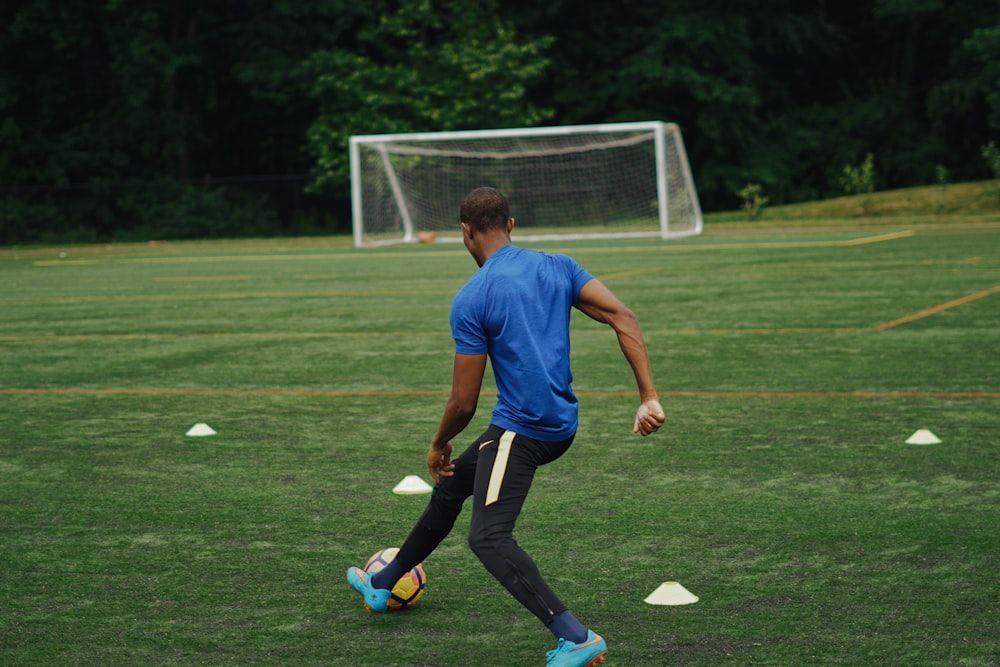
A grassroots warm up has about six minutes in it. Any longer and you have spent a quarter of the session getting ready for the session.
The eight below all run on cones, bibs and a ball each. None of them need a demonstration longer than one sentence, and none of them leave anyone standing in a queue. The rule underneath all of them is the same: if the warm up has a ball in it, kids warm up without being told to.
The four with a ball
1. Traffic lights
You need: a ball each, a green cone and a red cone, a start line and a finish line.
You stand at the far end with your back to them. Green cone up and everyone dribbles towards you. Red cone up and you turn around two seconds later. Any ball you catch moving goes back to the start line. First player to cross your line wins and takes over as the light.
 © CoachTruly.com
Why it works: the two second delay is the whole drill. They have to dribble at full speed and still kill the ball dead on the signal, which is close control under pressure dressed up as a race.
2. Beehive tag
You need: a ball each, bibs for one or two players, a coned area with a marked spot in the middle.
Everyone dribbles. The bibs are bees and sting by touching someone. First sting, you keep one hand on the spot you were stung and carry on dribbling. Second sting, the other hand goes on a new spot. Third sting, you dribble to the medical point in the middle and buy your way back in with a task, say fifteen juggles or twenty inside-of-foot touches.
 © CoachTruly.com
Why it works: the handicap does the coaching for you. A hand pinned to your hip pulls the ball closer to your feet without anyone being told to keep it close, and nobody is ever out of the game.
3. Sharks and minnows
You need: a ball each for the minnows, bibs for two sharks, a channel marked with cones.
Minnows dribble from one end of the channel to the other. Sharks try to knock the balls out. Lose your ball and you become a shark.
Why it works: the game gets harder as it goes, so the last two minutes are the most intense without you changing anything.
4. Numbers press
You need: one ball per group of five or six.
Players pass in a loose circle. Call a number and that player sprints in to win the ball back while the rest keep it away.
Why it works: it is a rondo with a reason to run, which is what makes it work for age groups that find a standing rondo boring.
The four with almost no setup
5. Shadow tag
You need: nothing.
Pairs. One leads, one follows a step behind copying everything: direction, speed, turns, the lot. Swap after a minute.
Why it works: it is the only one on this list with no ball, and it is the best of them for actually raising a heart rate. Use it on cold nights.
6. Two touch gates
You need: a ball per pair, four cones per pair for two gates about five metres apart.
Partners face each other, each behind their own gate, and pass back and forth with one or two touches, always through the gate. Push the gates further apart to make it harder. Progression: take the first touch with the outside of the foot to the side of the gate, then pass through your partner's gate.
 © CoachTruly.com
Why it works: the gate is a target that answers for you. They know instantly whether the pass was accurate, so you are not the one calling every ball good or bad.
7. Bulldog with a ball
You need: a ball each, a coned grid.
Everyone dribbles from one side to the other. Two players start without a ball and try to knock balls out. Lose yours and you join them.
Why it works: same escalation as sharks and minnows but in a wider space, so it suits a bigger group.
8. Keep away, three v one
You need: one ball per four players, four cones.
Three keep the ball, one in the middle. The player on the ball always has two passing options open. Whoever loses it or plays the poor pass goes in the middle. Add a touch limit once it is running, or go to four against one if the middle is too easy.
 © CoachTruly.com
Why it works: two open options at all times is what keeps it moving at this age. The moment they have to hunt for a pass it stops being a warm up and turns into a queue.
One change worth making: the drill rotates on mistakes. If you have a player who keeps ending up back in the middle, switch to a thirty second timer instead so the rotation stops being a punishment.
How to pick one
Cold night, get them moving before anything else: shadow tag or traffic lights.
Big group, not enough space: two touch gates or bulldog.
They arrived flat and you need the energy up fast: sharks and minnows.
The session that follows is about keeping the ball: numbers press or three v one, so the warm up already looks like the main part.
The one thing worth doing every week is finishing the warm up while they still want more of it. A warm up that runs two minutes too long is the reason the rest of the session feels like work.
Where to find more
Four of the eight above are drawn up properly in our free drill database, linked from each one. The rest of it is worth a scroll too: it is open, there is no signup, and the fun and movement themes are where most of the warm up material sits.