Passing and Movement: 60-Minute Football Session U10+
After a pass, the game goes on. In this one-hour session, the player looks for a new position where they can receive the ball back. You start with a small-sided game, practise movement in pairs and then try it in a 3v3 game. At the end, the players use what they have learned in a free game.
The plan does not require a set number of players in the team. Form pairs and small game groups. Repeat the same task in parallel areas, depending on how many groups you can coach.
U10+ is an approximate starting age, not an upper age limit. Players should be able to dribble, pass short and control the ball. The same session can suit an older group too. Choose the difficulty based on the players' experience and how the session is going.
If the group still needs a lot of practice moving with the ball and scoring, choose a suitable plan from the U8+ sessions.
U10+ · 60 min
Passing and movement
Have a ball for each pair, spare balls, cones and bibs. Form small game groups. Mark a pitch of about 20 x 15 metres for each group, for example, and leave space between the pitches. Adapt the area to the game format. Set up the goals at opposite ends and mark the end zones of about three metres in advance. Use parallel pitches only as many as you can coach. The times include instructions, drink breaks and transitions.
- Game: Ball Quickly into Play10 min
- Passing and movement in pairs10 min
- 3v3 with goal areas15 min
- Basic game (e.g. 3v3 / 4v4)20 min
- Team wrap-up5 min
Open the complete plan without signing in. Adjust the timings and notes for your team.
Game: Ball Quickly into Play · 10 min
 © CoachTruly.com
Play small-sided games, for example 2v2 or 3v3, to two goals at opposite ends of the pitch without goalkeepers. Keep spare balls outside the lines. The team restarting from the touchline takes the nearest ball and restarts with a pass. Over any other line, the opponents restart with a pass from the nearest line. After a goal, the other team restarts from its own end. Defenders give space for the restart. Only one ball is in play at a time. Leave out the three-second extra rule. Watch whether the passer moves to become available again.
Passing and movement in pairs · 10 min
 © CoachTruly.com
Form pairs and give each pair a ball and its own space. Start with a passing distance of about five metres. Pass to your partner and move into a free position for a new pass. The receiver controls the ball and looks for the partner's new position. If players are left over, one group works as a three: pass and move, and the next player chooses a free receiver. Make it easier by shortening the distance. Once passes are succeeding, the receiver watches the partner's movement before the ball arrives.
3v3 with goal areas · 15 min
 © CoachTruly.com
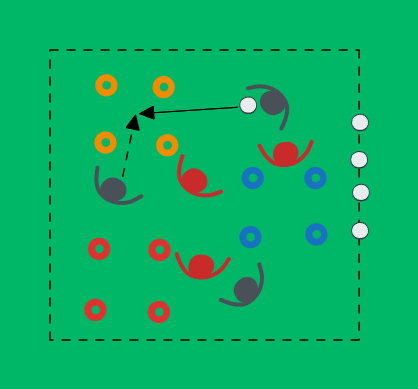
Play the end zone game in small groups. The drill bank format is 3v3; you can adapt it to 2v2 and make the area smaller. Each team attacks the end zone at the opponent's end. A goal is scored by a pass to a teammate in the end zone when they control the ball. After a goal, the other team restarts from its own end zone. When the ball crosses a line, the opponents restart with a pass from the line and defenders give space. At first, a player may wait in the end zone. Once the game flows, they may move in only after the pass has been played. Make it easier by enlarging the area. Ask: where can the player on the ball find a new passing angle?
Basic game (e.g. 3v3 / 4v4) · 20 min
 © CoachTruly.com
Play small-sided games to normal goals at opposite ends of the pitch, without goalkeepers. The end zones are no longer used. After a goal, the other team restarts from its own end, and after the ball crosses a line, the opponents pass the ball in from the line. Defenders give space. No required number of passes or touch limit: a player may also dribble. Let the game flow and watch whether the passer finds a new position. Go through one observation at the drink break. Change opponents at the break if you wish.
Team wrap-up · 5 min
Ask the players where it was worth moving after a pass and how they recognised a free passing angle. Collect the equipment. Write down one observation in the plan for the next session.
Drill instructions and editable plan: coachtruly.com/blog/u10-passing-and-moving. A CoachTruly session. Background source: FIFA Training Centre, Give and go.
What should the coach watch for?
Keep your attention on one thing: does the passer offer a new passing angle? Simply running after the pass is not enough if the player ends up hidden behind an opponent. The movement can be a short step to the side, backwards or forwards, depending on the situation.
In the FIFA Training Centre Give and go session, passing and movement after the pass are practised before the small-sided game. In this CoachTruly plan, we use the same coaching theme with our own drills. The groupings, the timings and the variations below belong to this plan.
Start with a small-sided game
© CoachTruly.comDivide the players into small teams, for example 2v2 or 3v3 games. Play to two goals at opposite ends of the pitch, without goalkeepers. Keep spare balls at the side of the pitch. The team restarting from the touchline takes the nearest ball and restarts with a pass. After a goal, the other team restarts from its own end.
If the ball goes out over any other line, the opponents restart with a pass from the nearest line. Defenders give space. Only one ball is in play at a time. This version leaves out the drill bank's extra three-second rule.
Start calmly and let the players get going. Watch what happens to the passer next. Do they stop and watch, or do they find a new position? Do not require a set number of passes before a goal.
Passing and movement in pairs
© CoachTruly.comForm pairs. Each pair has a ball and its own space. Start about five metres apart. The player passes and moves to a new position. The partner controls the ball, looks for the new passing angle and passes the ball back.
The movement does not need to be long. It has to make the next pass possible. Leave space between the pairs so that the passing lanes do not cross.
- Easier: shorten the passing distance and give the receiver time to stop the ball.
- Harder: ask the receiver to look at the partner's movement before the ball arrives and to direct the first touch in a suitable direction.
- Question for the players: where can you move so that your partner can see you and pass back?
Take the movement into the game with end zones
© CoachTruly.comContinue in small groups. The drill bank session is 3v3, but you can adapt it to 2v2 in a smaller area. Replace the goals with end zones about three metres deep. A goal is scored when a player passes to a teammate in the end zone at the opponent's end and the receiver controls the ball.
In this version of the session, the team that conceded restarts from its own end zone. When the ball crosses a line, the opponents restart with a pass from the line. Give the restarting player space. This way the group always knows who restarts.
At first, a player may wait in the end zone for the pass. Once the game is flowing, use the drill bank's progression: the receiver may move into the end zone only after the pass has been played. Do not introduce this rule if keeping possession is still difficult.
Also watch the passer's movement in the middle area. Do they get open again if the forward route closes? At a break, ask where the player on the ball found a free passing angle.
Finish with a game without extra rules
© CoachTruly.comGo back to normal goals at opposite ends of the pitch. The end zones are no longer used. Let the players choose when to pass and when to dribble. After a goal, restart from your own end, and after the ball crosses a line, the opponents restart with a pass from the line.
Watch whether the passer shows up in a new position even without a separate reminder. At the drink break, bring up one situation seen in the game. A long discussion in the middle of the game takes time away from the playing itself.
Finally, ask what helped to get the ball back. Write down your own observation in the plan for next time.
Adapt the session to the players who turn up
Players do not divide evenly: one passing group can work as a three. The passer moves, and the next player on the ball chooses a free receiver. In a small-sided game, the extra player can help the team in possession. Change this role regularly.
More players: set up similar areas and divide the players into small groups. Adapt the pitch size to the game format. Make the area smaller if the game turns into long solo dribbling, or add space if players do not have time to spot a passing position.
Only one coach: keep the same familiar task on parallel pitches and place the pitches within sight. If all the games need constant help, simplify the rules and reduce the number of simultaneous areas. Do not add parallel tasks just for the sake of the plan.
The session is too easy: first make the timing of the movement into the end zone harder. You can also make the playing area slightly smaller. Change only one thing at a time and see whether the players still have time to notice and choose.
Take the plan to your next sessions
Press the plan's Edit this session button. The drills, durations and notes open ready to use. You can change the order, change the times and add instructions for your own group without signing in.
You can also share the edited session with another coach using a link. Without an account, a shared plan is kept for 14 days from the first share. Save the session to your account if you want to keep it for later use.
The session plan template helps you build the next session on the observations from this one. You can find more options in the football drill database.